
Short answer
The difference is which steps are done by hand. In a semi-automatic line an operator feeds corners and positions each shell on the paper; machines glue and wrap. An automatic machine such as the HF-5040 also feeds, tapes and positions, and runs 18–25 pieces per minute against 15–20 for a semi-automatic forming line.
Updated · figures from the HORFON specification sheets
On this page · 9
- Which steps stay manual on a semi-automatic rigid box line
- Three levels of automation, step by step
- Corner pasting: HF-40 manual vs HF-500 automatic
- Forming: HF-450 line vs HF-5040 automatic machine
- Box-to-case assembly: HF-808 vs HF-8288
- Is an automatic rigid box line faster?
- Changeover and setup
- Upgrading a semi-automatic line in stages
- How to choose between automatic and semi-automatic
Which steps stay manual on a semi-automatic rigid box line
Gluing and wrapping are done by machine in both cases. What changes is the handling between them. On a semi-automatic line an operator places each taped shell on the glued sheet by eye, against printed marks, and feeds the forming machine. On an automatic line a camera reads the sheet and a robot arm places the shell.
Three levels of automation, step by step
For a lid-and-base rigid box there are three ways to equip the same five operations. The middle one is often overlooked: it keeps the separate machines of a semi-automatic line and automates only the positioning.
| Operation | Semi-automatic set | Automatic modular line | All-in-one machine |
|---|---|---|---|
| V grooving | HF-1200 | HF-1200 | HF-1200, before the machine |
| Corner taping | HF-500, or HF-40 by hand | HF-500 | Inside the HF-5040 |
| Paper gluing | HF-850A | HF-1050 | Inside the HF-5040 |
| Positioning | By hand | HF-1050, camera and robot | Inside the HF-5040, camera and robot |
| Wrapping and folding | HF-450 | HF-450 | Inside the HF-5040 |
| Line speed | 15–20 pcs/min | 15–20 pcs/min | 18–25 pcs/min |
Corner pasting: HF-40 manual vs HF-500 automatic
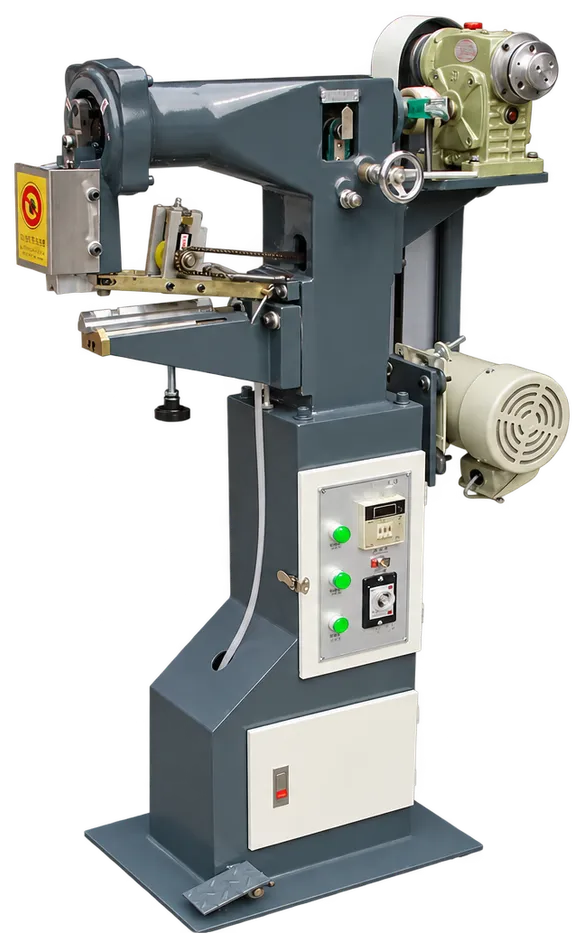
The two machines take almost the same range of boxes. The difference is the stroke: the HF-40 tapes one corner each time the operator presents the shell, and the HF-500 tapes all four at once. Four corners in one stroke also means the four are taped identically, which cuts rejects at the wrapping step.
Forming: HF-450 line vs HF-5040 automatic machine
| Parameter | 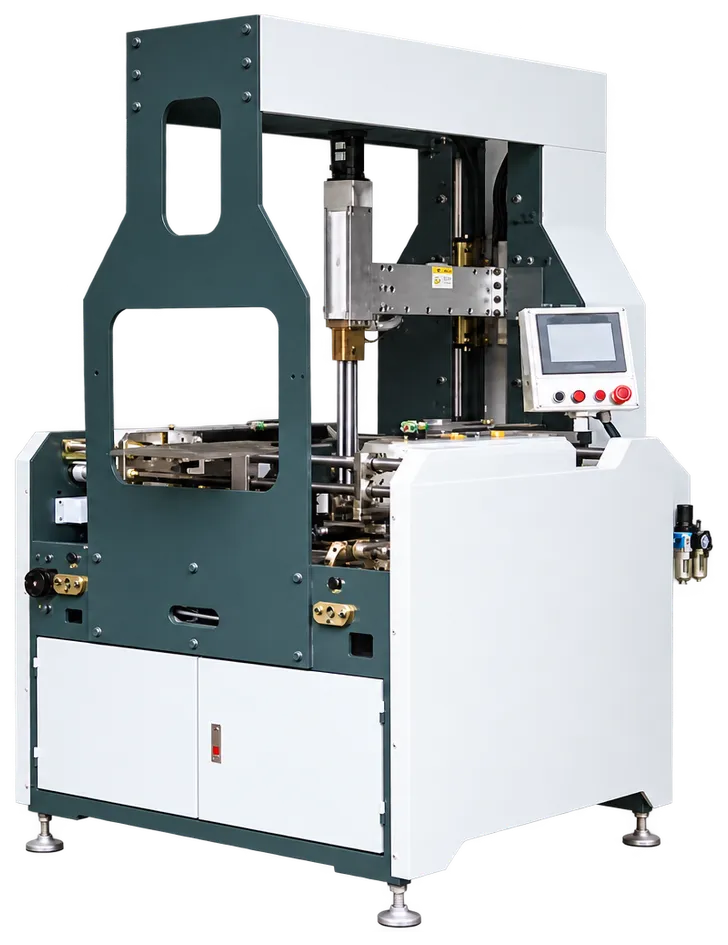 | 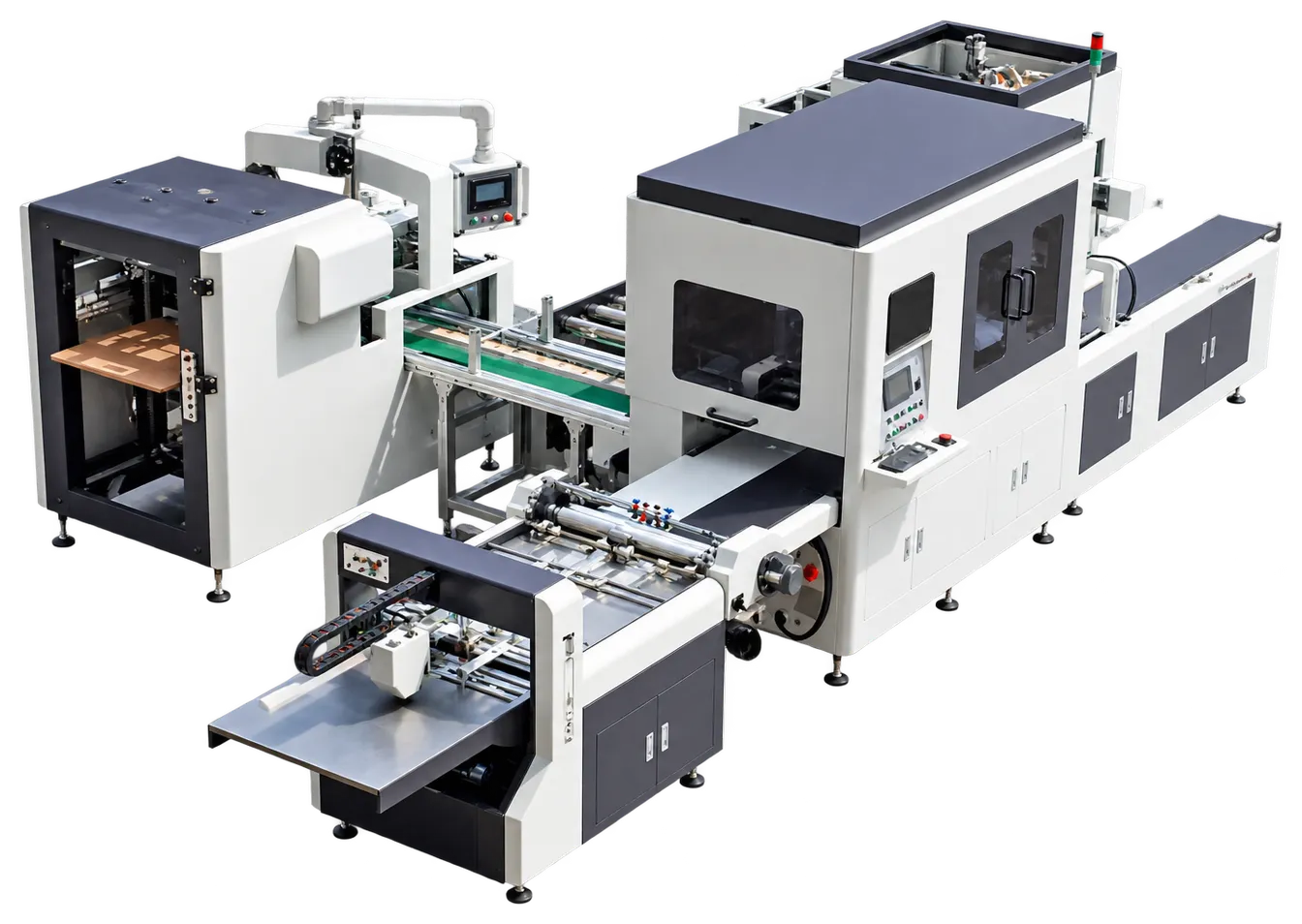 |
|---|---|---|
| Speed | 15–20 pcs/min | 18–25 pcs/min |
| Largest box | 480 × 400 × 120 mm | 500 × 400 × 120 mm |
| Smallest box | 45 × 45 × 15 mm | 65 × 65 × 20 mm |
| Positioning accuracy | — | ±0.1 mm |
| Motor or heating power | 2.5 kW / 220 V | 15 kW / 380 V, 3-phase |
| Footprint (L × W × H) | 1400 × 1100 × 2050 mm | 8200 × 4200 × 2150 mm |
Box-to-case assembly: HF-808 vs HF-8288
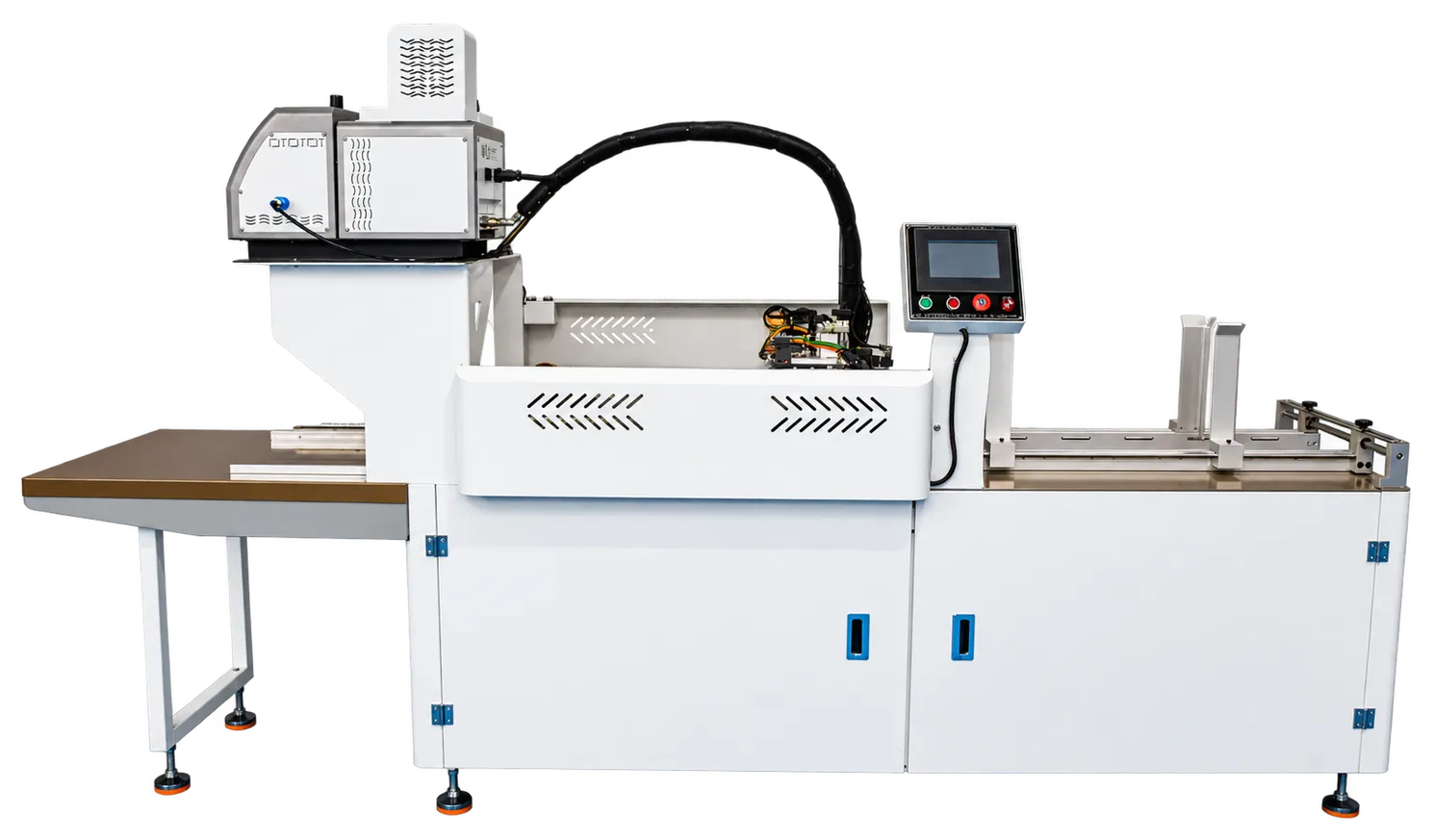
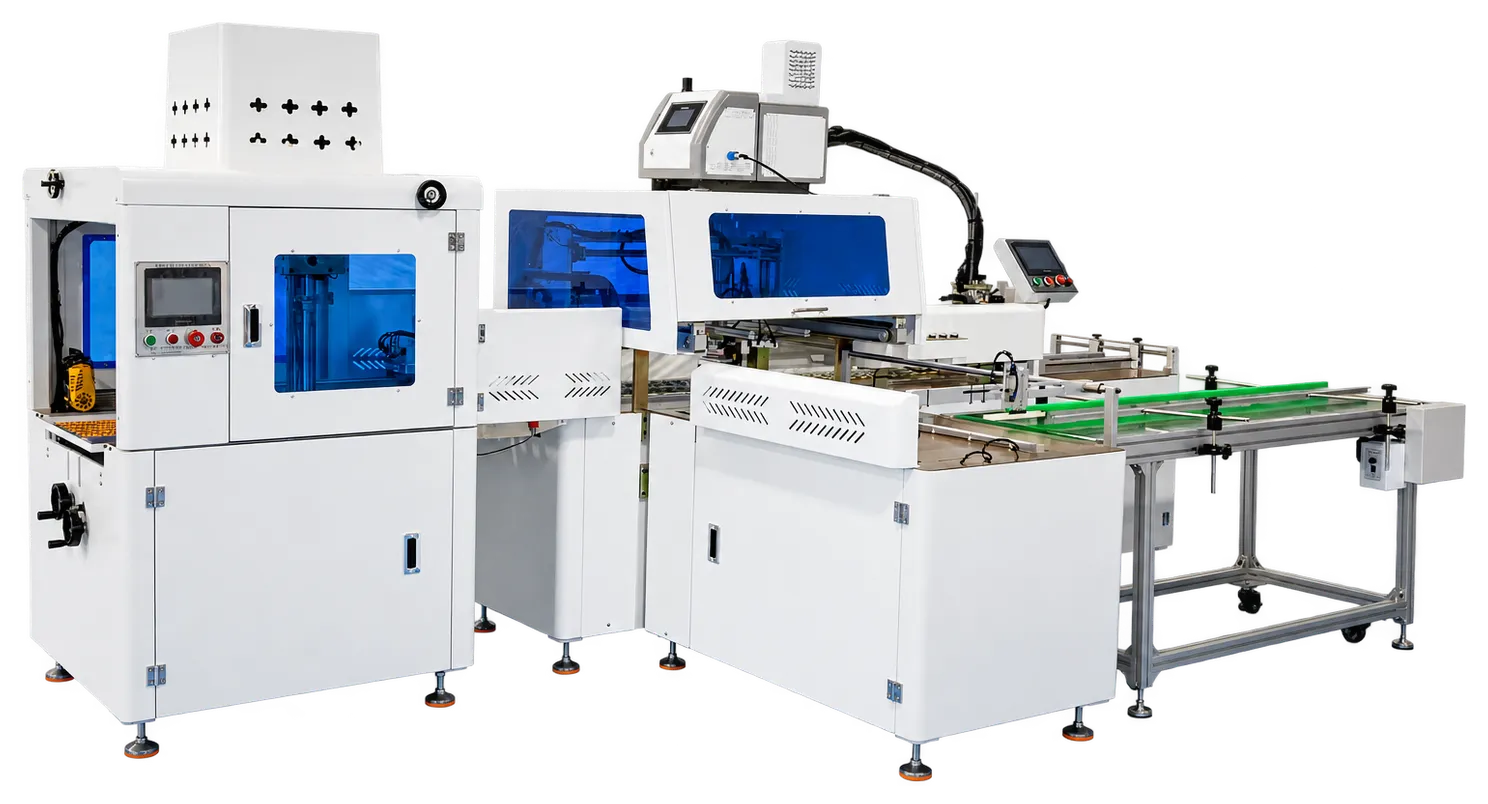
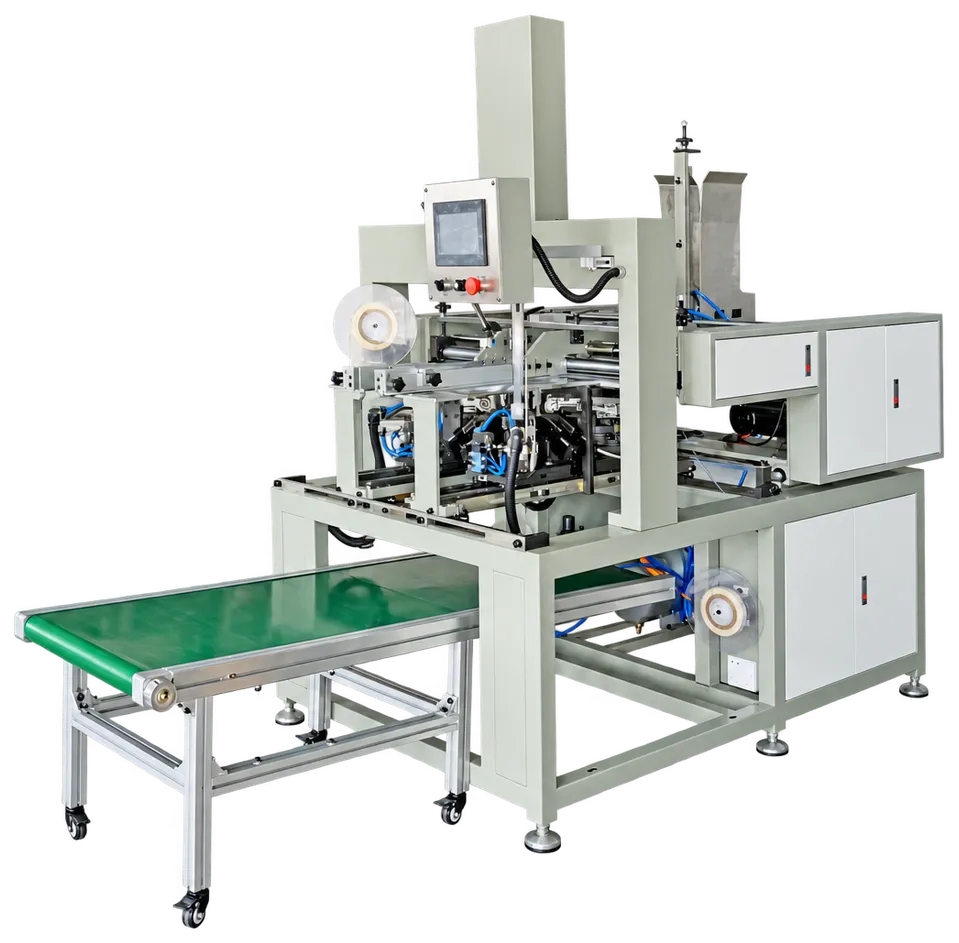
Both assembly machines are rated at 15–22 pieces per minute. They differ in how much of the handling the machine does: the HF-8288 is an automatic line 5.55 m long and 1,200 kg, the HF-808 a semi-automatic station 3.2 m long and 600 kg.
Is an automatic rigid box line faster?
Less than most buyers expect. The HF-5040 is rated at 18–25 pieces per minute and a line ending in an HF-450 at 15–20. A modular line with an HF-1050 positions at up to 30 sheets per minute, but the forming machine after it still wraps 15–20, so the line speed does not change.
What automation changes is consistency and handling. Every shell is placed to ±0.1 mm whoever is on shift, and the hand positioning station between gluing and forming disappears. Speed comes from adding forming capacity, not from automating the positioning.
Changeover and setup
- HF-450: the box size is entered on the touch screen and the forming parameters are set automatically.
- HF-500: electronic plus manual adjustment, and one machine covers a wide range of sizes.
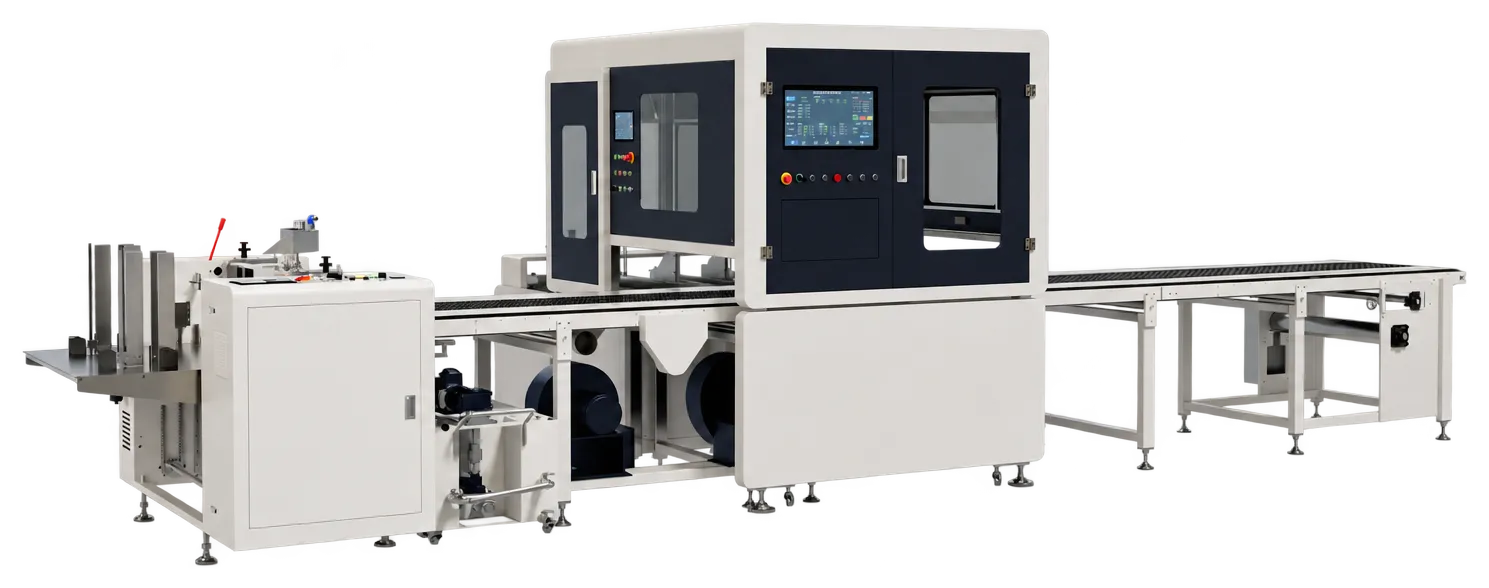
- HF-5040: one control system sets the box size for every step, with a servo and pneumatic wrapping unit adjusted from the screen.
- HF-5040 loading: it carries a 1000 mm stack of board and a 500 mm stack of paper.
Upgrading a semi-automatic line in stages
- 01
Start with the semi-automatic set
HF-1200, HF-500, HF-850A and HF-450. Choose the servo version of the HF-850A if automation is likely later.
- 02
Automate the positioning
Add a Yamaha robot to the servo HF-850A to turn it into an automatic positioning machine, or replace the gluing machine with an HF-1050, which glues and positions to ±0.1 mm.
- 03
Add forming capacity
Forming is the slowest step at 15–20 pcs/min, so a second forming machine is what raises the output of the line.
How to choose between automatic and semi-automatic
- Many sizes, short runs: semi-automatic machines change over with simple adjustments and suit a varied order book.
- Printed boxes with tight registration: camera positioning holds ±0.1 mm on every piece; hand positioning depends on the operator.
- Small boxes and thick board: the HF-450 forms down to 45 × 45 × 15 mm in board up to 4 mm. The HF-5040 starts at 65 × 65 × 20 mm and takes 1–3 mm board.
- Floor space: the HF-5040 needs about 8.2 × 4.2 m. An HF-450 is 1.4 × 1.1 m, plus the gluing machine in front of it.
- Power: the HF-5040 needs 380 V three-phase at 15 kW. The HF-40, HF-500 and HF-450 run on 220 V.
Machines in this guide
Common questions
What is the main difference between automatic and semi-automatic rigid box machines?
Positioning. On a semi-automatic line an operator places each shell on the glued paper by hand. On an automatic line a camera and a robot arm place it to ±0.1 mm. Gluing and wrapping are done by machine in both.
Is the HF-450 an automatic machine?
Yes: it sets itself from the box size typed on the touch screen and wraps, folds and presses automatically. A line built around it is called semi-automatic only because the shell is positioned on the paper by hand before it.
How much faster is the HF-5040 than a semi-automatic line?
The HF-5040 is rated at 18–25 pieces per minute and a line ending in the HF-450 at 15–20. At the top of both ranges that is 25 against 20 pieces per minute.
Can a semi-automatic line be upgraded to automatic later?
Yes. A Yamaha robot can be added to the servo version of the HF-850A gluing machine to make it an automatic positioning machine, or the gluing machine can be replaced by an HF-1050. The grooving, corner pasting and forming machines stay.
Which rigid box machines run on 220 V?
The HF-40, HF-500, HF-450 and HF-1200 run on 220 V, as do the HF-808 and HF-8288 assembly machines. The HF-850A gluing machine, the HF-1050 and the HF-5040 need 380 V.
Which option makes the smallest boxes?
The semi-automatic set. The HF-450 forms boxes down to 45 × 45 × 15 mm. The HF-1050 positions boxes from 60 × 60 × 15 mm and the HF-5040 starts at 65 × 65 × 20 mm.