
Short answer
A rigid box is made in six steps: slit the greyboard, cut V-grooves where it folds, fold it into a shell and tape the corners, coat the cover paper with glue, position the shell on the paper, then wrap the paper up the walls and turn it in. Each step has its own machine.
Updated · figures from the HORFON specification sheets
On this page · 9
What a rigid box is made of
A rigid box, also called a set-up box, has two layers. The structure is greyboard: a dense board that does not fold flat, which is what gives the box its stiffness. The surface is a sheet of printed or specialty paper glued over the board. Two consumables hold it together: tape on the corners of the board shell, and glue between paper and board.
The machines on this page take greyboard from 0.8 to 4 mm thick and cover paper from 80 to 350 g/m², depending on the machine. The table further down gives the range for each one.
The six steps of making a rigid box
- 01
Slit the board
Full greyboard sheets are cut into blanks. The HF-1300 slits sheets up to 1200 × 800 mm at 20–80 sheets/min.
- 02
Groove the board
V-grooves are cut where the walls fold. The HF-1200 cuts up to 8 grooves per pass, to ±0.05–0.1 mm, in 0.8–4 mm board.
- 03
Tape the corners
The blank is folded into a shell and its corners are taped. The HF-500 tapes four corners at once at 30–55 pcs/min.
- 04
Glue the paper
The cover paper is fed sheet by sheet and coated with glue. The HF-850A is a gluing machine only and runs 80–250 g/m² paper at up to 45 pcs/min.
- 05
Position the box
The taped shell is placed exactly on the glued paper, by hand or by machine. The HF-1050 glues the paper itself and positions by camera and Yamaha robot to ±0.1 mm, so it covers steps four and five together.
- 06
Wrap and fold
The paper is wrapped up the walls, the ears are folded and the paper is turned in. The HF-450 does this at 15–20 pcs/min.
Why the board is V-grooved
Greyboard is too stiff to fold cleanly. Bent as it is, it gives a rounded, cracked edge. A V-groove removes a wedge of board along the fold line and leaves a thin skin as a hinge, so the wall folds up to a sharp, square corner. The grooves have to be straight and evenly deep for the walls to fold square.
The HF-1200 grooves board from 100 × 120 mm to 950 × 1000 mm at 25–50 m/min. Its two clamped blades are adjusted on the machine, in the ranges 80–120° and 120–140°, so a different angle does not need a different blade. The offcut comes out as a continuous strip rather than dust.
Why the corners are taped
Once the walls are folded up, nothing holds them together until the paper is on. Tape across each corner fixes the shell in shape so it can be handled, stacked and wrapped. The HF-500 tapes all four corners in one stroke with PVC, PET or paper tape, 15, 19 or 24 mm wide. The hand-fed HF-40 tapes one corner at a time, at 10–20 pcs/min.
How the paper is glued and positioned
The cover sheet is coated with glue over its whole face, then the shell is set down on it while the glue is still open. This is the step that decides how the finished box looks: if the shell lands slightly off, the print runs crooked along an edge and the turn-in is uneven.
| Method | Gluing | Positioning |
|---|---|---|
| By hand | HF-850A, 80–250 g/m² paper, up to 45 pcs/min | An operator places each shell against printed marks |
| Positioning line | Included in the HF-1050 | Camera and Yamaha robot, ±0.1 mm, 15–30 sheets/min |
| All-in-one machine | Included in the HF-5040 | Camera and robot arm, ±0.1 mm, 18–25 pcs/min |
The HF-850A and the HF-1050 are alternatives, not two machines in a row: the HF-1050 already glues. More on camera positioning in what is a visual positioning machine.
What happens in the forming machine
The forming machine wraps the paper up the four walls of the shell. It then folds the corner ears, turns the top edge of the paper over the rim and down the inside, and presses the surfaces to drive out air bubbles. On the HF-450 the ears can be 10–90 mm and the turn-in 10–80 mm deep, and the settings follow from the box size typed on the touch screen.
Speed of each rigid box machine
| Parameter | 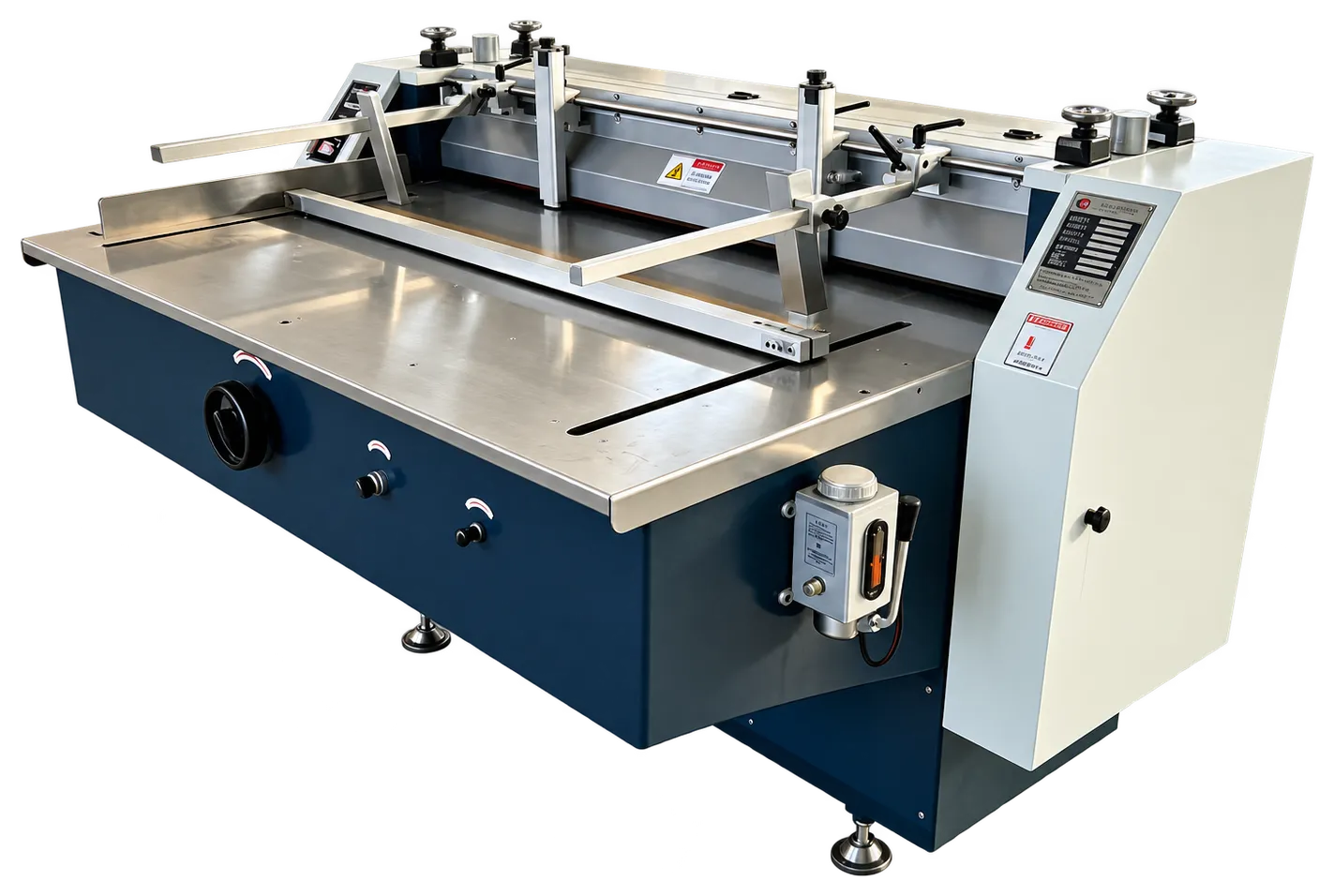 | 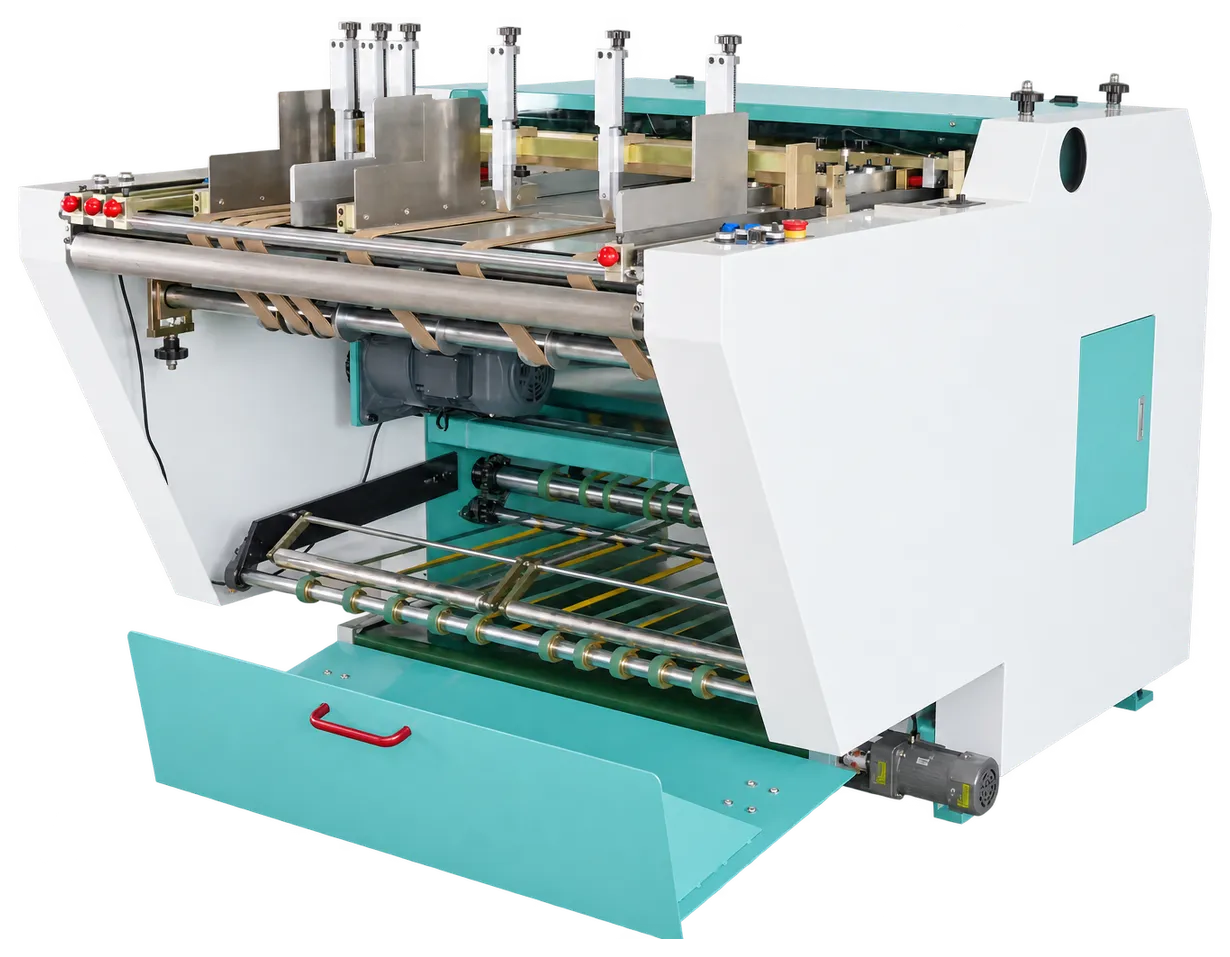 | 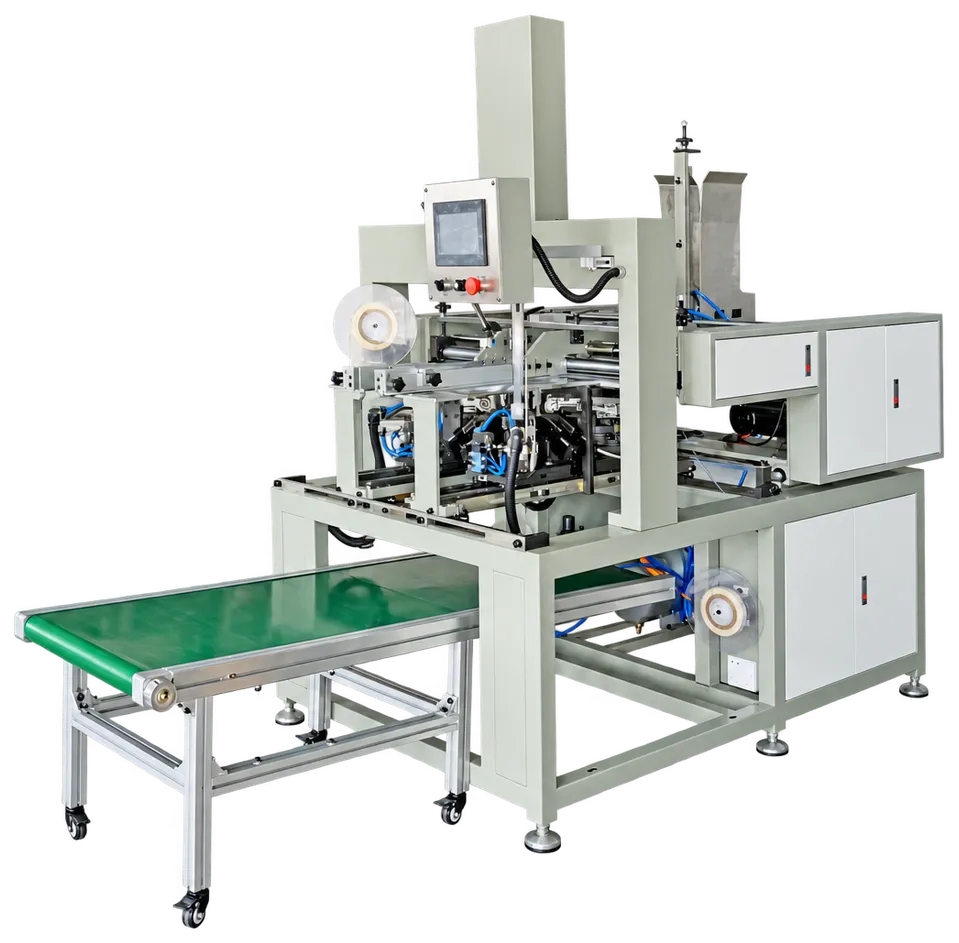 | 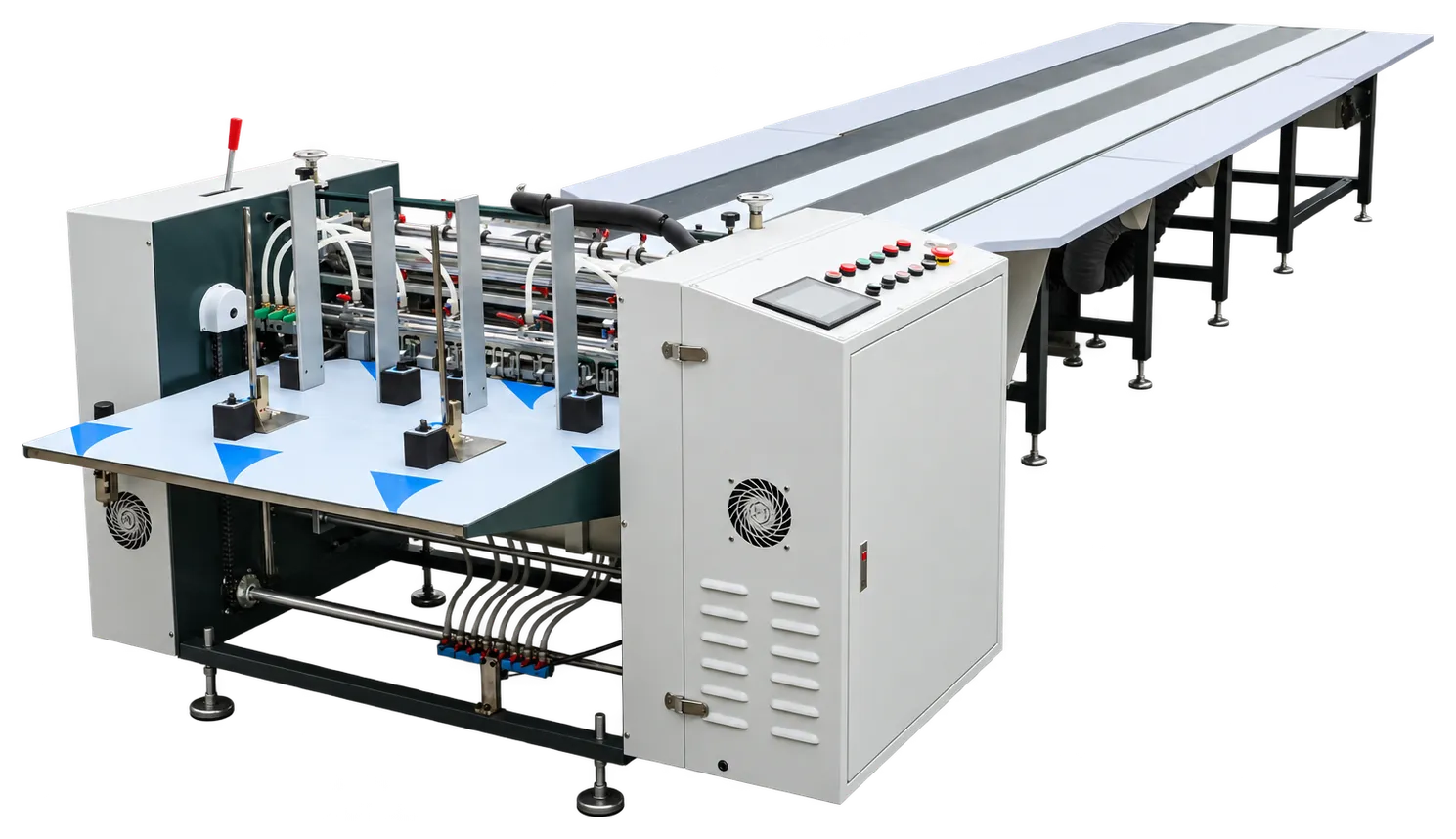 | 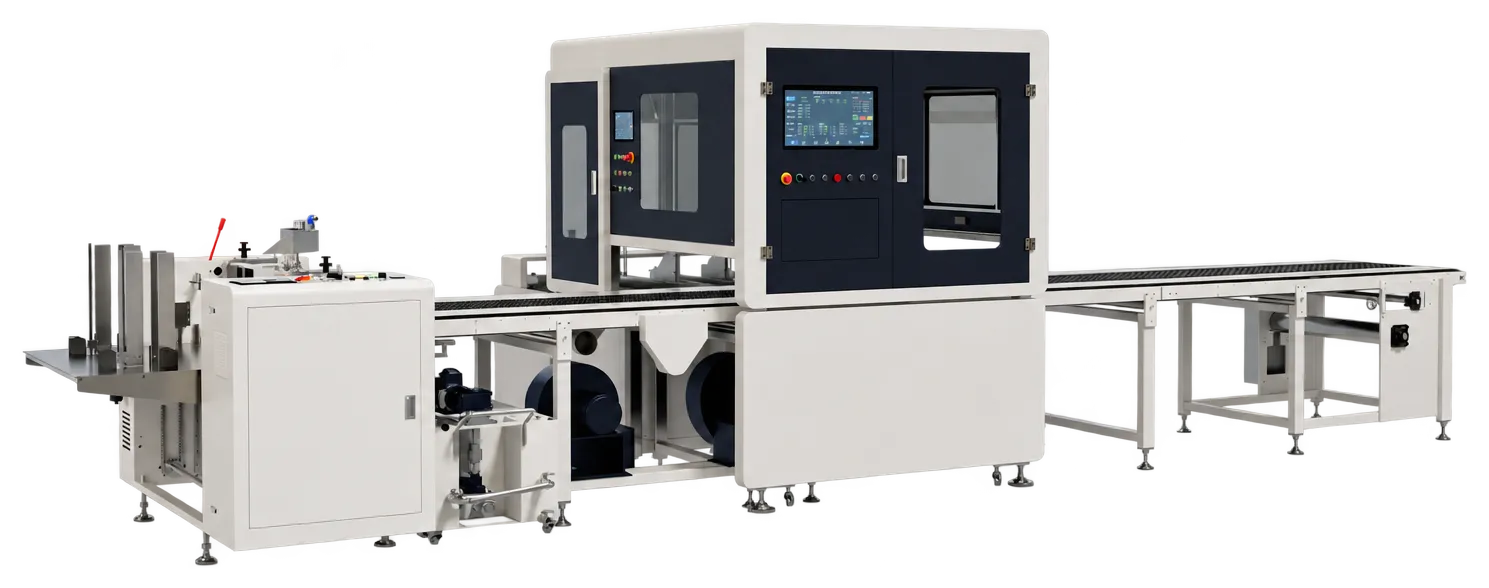 | 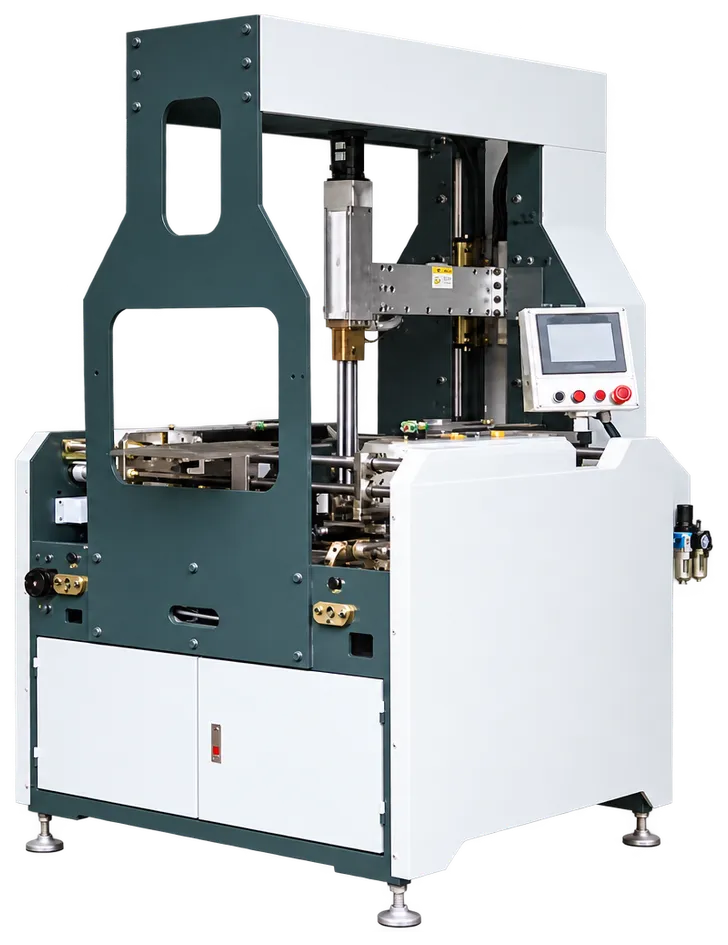 |
|---|---|---|---|---|---|---|
| Speed | 20–80 sheets/min | 25–50 m/min | 30–55 pcs/min | Servo version: 7–45 pcs/min · Standard version: 7–40 pcs/min | 15–30 sheets/min | 15–20 pcs/min |
| Board thickness | 1.2–3 mm | 0.8–4 mm | 0.8–4 mm | — | 1–3 mm | 0.8–4 mm |
| Paper weight | — | — | — | 80–250 g/m² | 100–350 g/m² | — |
| Power | 2.2 kW | 2.2 kW / 220 V | 2.5 kW / 220 V | — | 7.5 kW | 2.5 kW / 220 V |
One machine instead of four
The HF-5040 combines steps three to six. It feeds and glues the paper, tapes the corners, positions the shell by camera and wraps all four sides, at 18–25 pcs/min, for boxes from 65 × 65 × 20 mm to 500 × 400 × 120 mm. Board still has to be slit and grooved before it.
How other rigid box styles differ
The six steps describe a lid-and-base box. Other styles reuse some of them and add their own.
| Box style | What changes | Machines added |
|---|---|---|
| Book-style magnetic box | Made as two parts, a hardcover case and an inner box, which are then glued together | HF-550 or HF-900 for the case, HF-600B and HF-600A for the closure, HF-8288 or HF-808 for assembly |
| Collapsible rigid box | A case plus folding side wings, assembled so the box ships flat | HF-8020 or HF-800D for the wings, HF-1150 for assembly |
| Drawer box (slipcase) | Formed in one pass from grooved board, held by suction, with no corner taping | HF-320 to form, HF-320A to fold in and press |
| Round box | The wall is a strip of greyboard bent into a ring, not a folded blank | HF-500C, HF-500A, HF-480 and HF-530 |
Machines in this guide
Common questions
How many machines does it take to make a rigid box?
Four for a semi-automatic lid-and-base line: the HF-1200 V grooving machine, the HF-500 corner pasting machine, the HF-850A paper gluing machine and the HF-450 box forming machine. A slitting machine in front is optional, and the HF-5040 replaces the last three with one machine.
Which step is the slowest in rigid box production?
Forming. The HF-450 wraps 15–20 pieces per minute, while corner pasting runs 30–55 and gluing up to 45. A lid-and-base box is two pieces, so that is 7 to 10 finished boxes per minute.
What board thickness can rigid box machines take?
The HF-1200 grooving machine, the HF-500 corner pasting machine and the HF-450 forming machine take 0.8–4 mm board. The HF-1050 positioning line and the HF-5040 take 1–3 mm, and the HF-1300 slitting machine 1.2–3 mm.
What paper can be used to wrap a rigid box?
The HF-850A gluing machine runs 80–250 g/m² paper, the HF-5040 runs 80–300 g/m² and the HF-1050 positioning line 100–350 g/m².
Is the corner taped before or after the paper is wrapped?
Before. The grooved blank is folded into a shell and the HF-500 tapes its four corners, at 30–55 pcs/min, so the shell holds its shape while it is positioned on the glued paper and wrapped.
Does the shell have to be positioned by hand?
No. After an HF-850A gluing machine an operator positions each shell by hand. The HF-1050 glues the paper and positions the shell with a camera and a Yamaha robot to ±0.1 mm, and the HF-5040 does the same inside one machine.