
Short answer
A visual positioning machine uses cameras to find the printed sheet and the greyboard, and a robot arm to place one on the other. The HF-1050 glues the paper and positions to ±0.1 mm at 15–30 sheets per minute, for rigid boxes up to 450 × 400 × 120 mm and hardcover cases up to 1000 × 500 mm.
Updated · figures from the HORFON specification sheets
On this page · 9
- What a visual positioning machine does
- How the HF-1050 works, step by step
- How accurate is visual positioning?
- HF-1050: one positioning machine, two kinds of line
- HF-1050, HF-5040, HF-550 or HF-8020: which camera machine?
- Adding camera positioning to a line you already have
- What the HF-1050 needs
- When camera positioning is worth it
- When hand positioning is still the better choice
What a visual positioning machine does
Wrapping paper around a box only looks right if the box sits in exactly the right place on the sheet: a millimetre off and the print runs crooked along an edge. Positioning by hand relies on the operator lining the shell up with printed marks. A visual positioning machine photographs the glued sheet, works out where the board must go, and has a robot arm put it there. The HF-1050 is a complete positioning line: it feeds the paper, glues it and positions with a Yamaha robot, so it needs no gluing machine in front of it.
How the HF-1050 works, step by step
- 01
Feed the paper
Cover sheets from 100 × 60 mm to 1050 × 750 mm, 100–350 g/m², are fed one at a time from a 280 mm stack.
- 02
Glue the paper
The sheet is coated with glue on the way to the positioning station. The machine has 4 kW of heating for the glue.
- 03
Locate by camera
The vision system finds where the board has to sit on the sheet.
- 04
Place by robot
A Yamaha robot sets the box shell or the case boards down on the glued sheet, to ±0.1 mm.
- 05
Pass on
A servo-driven conveyor carries the positioned work to the next machine: a box forming machine for boxes, a four-side wrapping machine for cases.
How accurate is visual positioning?
| Parameter | 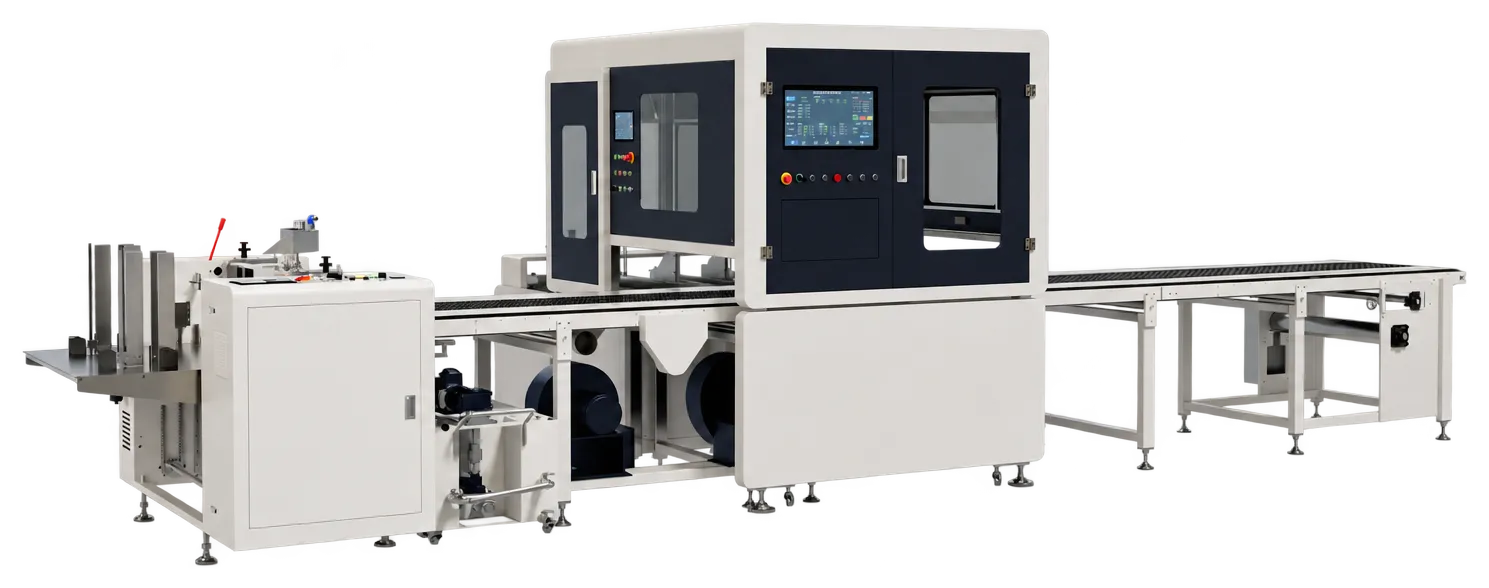 | 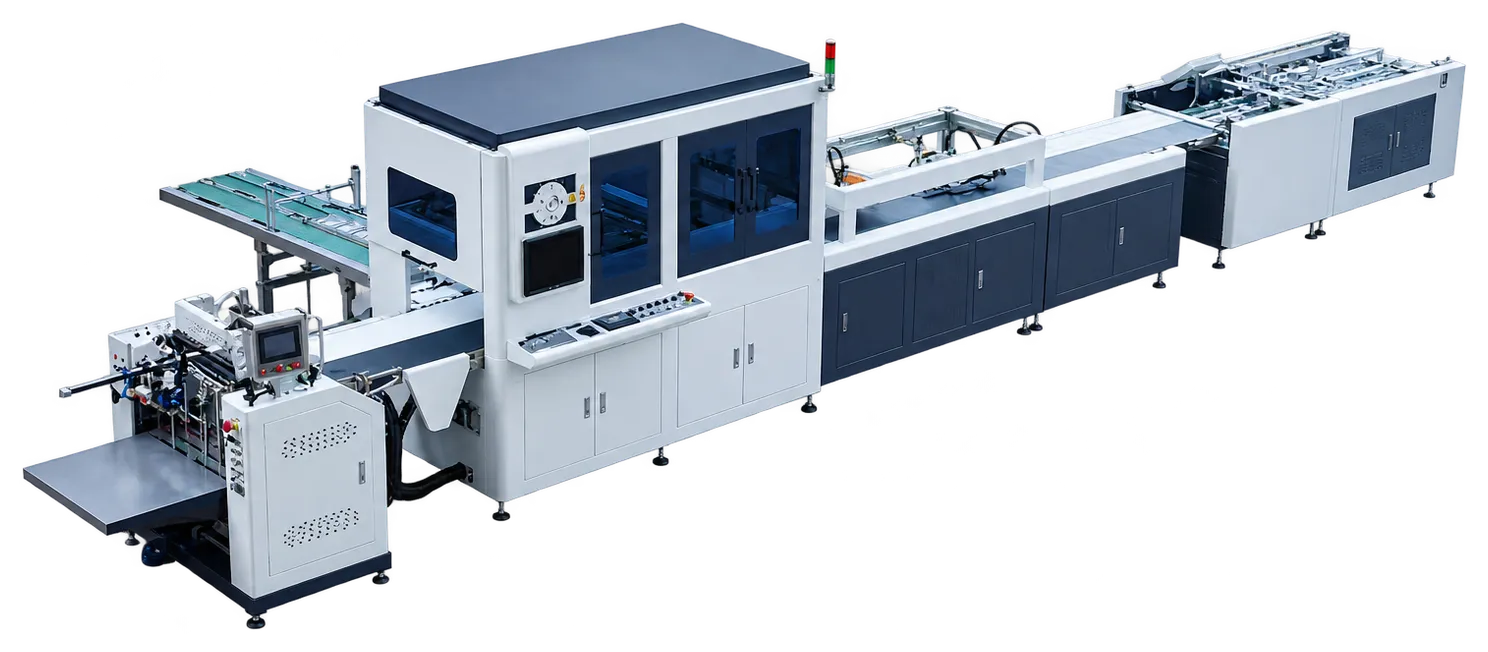 | 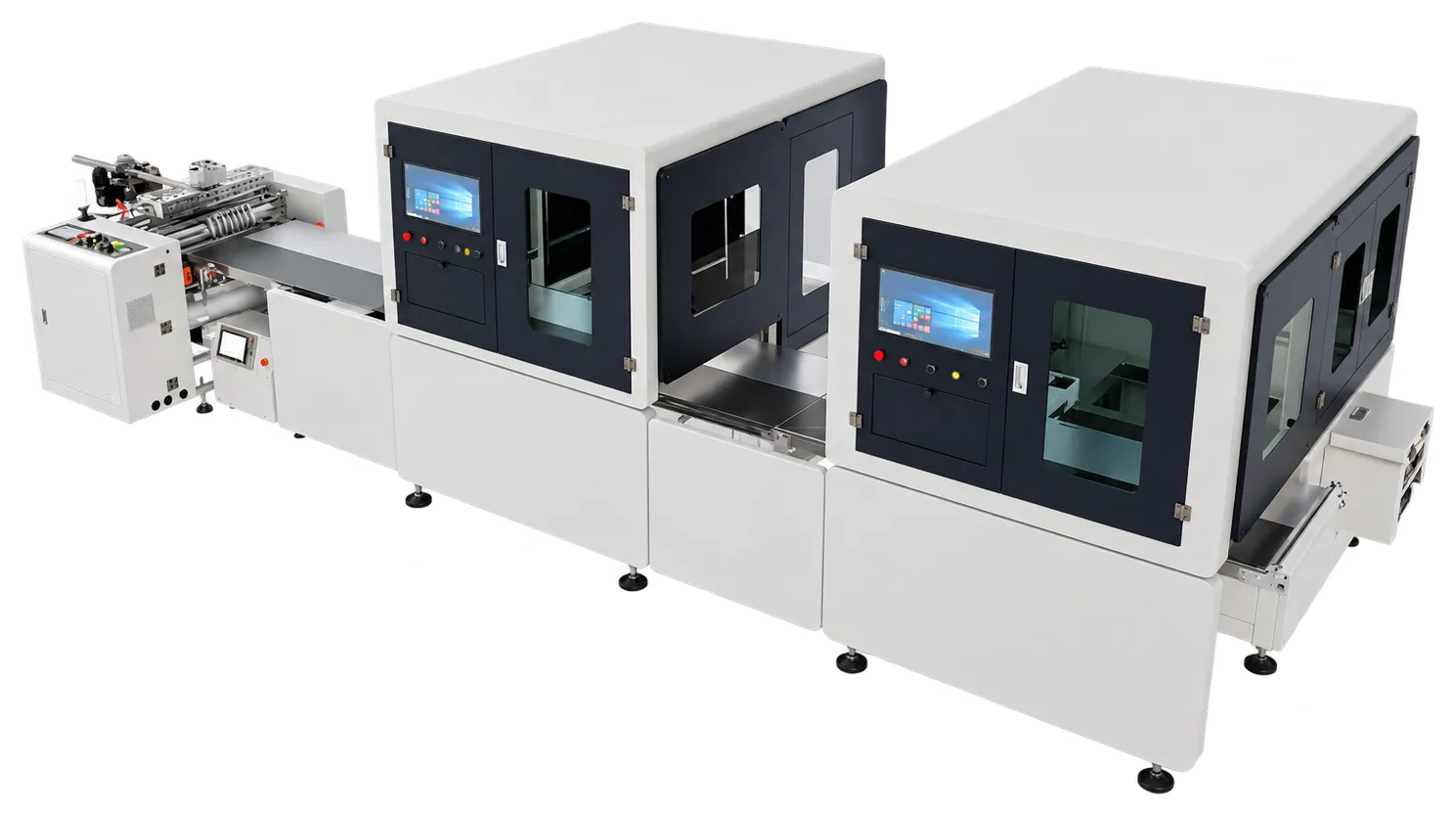 | 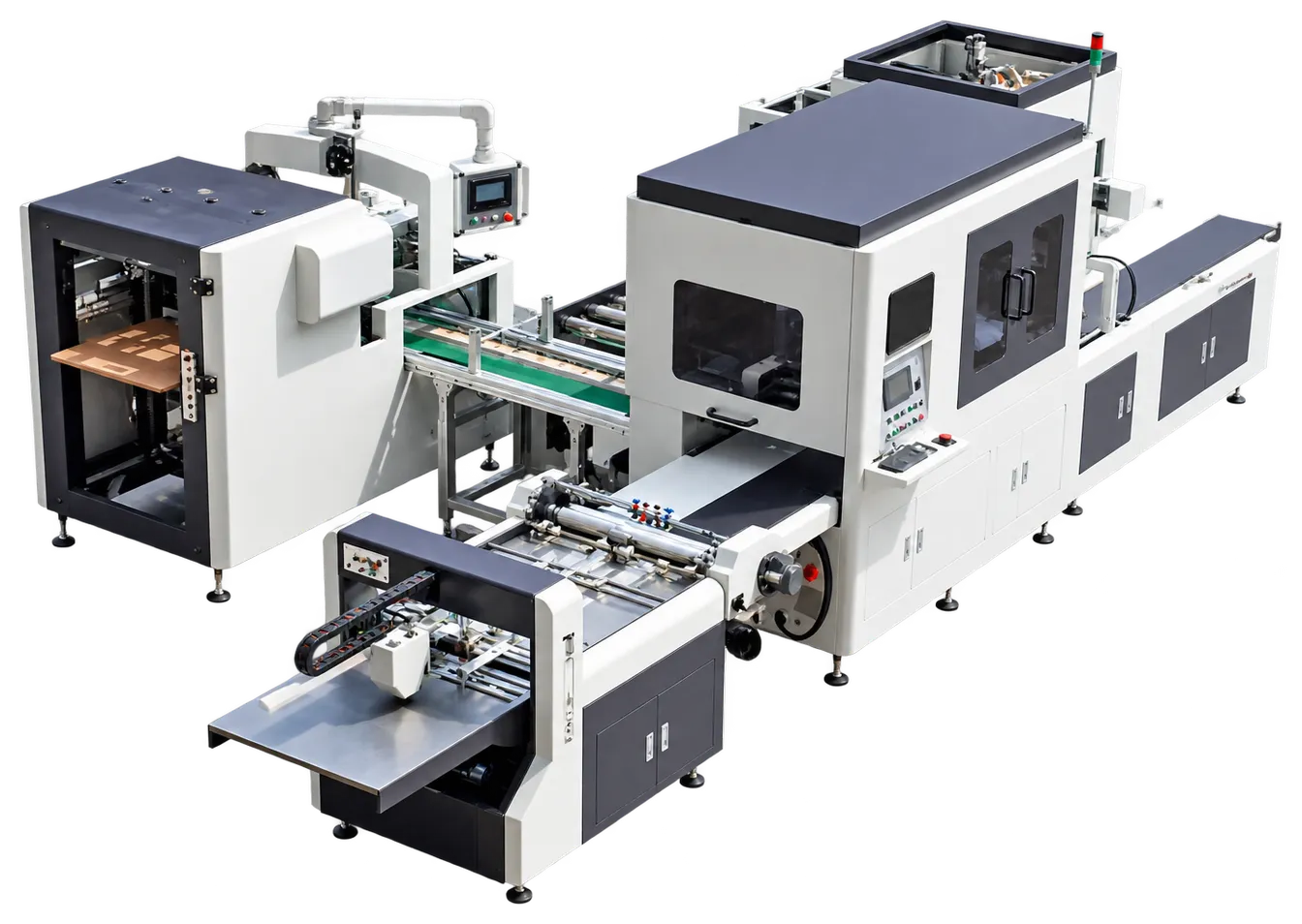 |
|---|---|---|---|---|
| Positioning accuracy | ±0.1 mm | ±0.1 mm | ±0.1 mm | ±0.1 mm |
| Speed | 15–30 sheets/min | 20–30 pcs/min | 20–30 sheets/min | 18–25 pcs/min |
| Paper weight | 100–350 g/m² | 80–300 g/m² | 100–350 g/m² | 80–300 g/m² |
| Board thickness | 1–3 mm | 1–4 mm | 1–3 mm | 1–3 mm |
All four camera-positioned machines are rated at ±0.1 mm. To put that figure in context, here is the stated accuracy of other operations on the same box.
| Operation | Machine | Stated accuracy |
|---|---|---|
| V grooving | HF-1200 | ±0.05–0.1 mm |
| Positioning board on paper | HF-1050, HF-550, HF-8020, HF-5040 | ±0.1 mm |
| Pasting magnets and iron sheets | HF-600B, HF-600A | ±0.5 mm |
| Drilling magnet recesses | HF-7090ZK | ±1–2 mm |
HF-1050: one positioning machine, two kinds of line
The HF-1050 positions both rigid box shells and hardcover case boards, so it can be built into different lines. With a corner pasting machine before it and a box forming machine after it, it makes an automatic rigid box line. With a four-side wrapping machine after it, it becomes an automatic case maker. It runs single positioning for boxes up to 450 × 400 × 120 mm, or double positioning for boxes up to 350 × 180 × 70 mm.
HF-1050, HF-5040, HF-550 or HF-8020: which camera machine?
| Machine | What it includes | What it makes |
|---|---|---|
| HF-1050 | Paper feeding, gluing, positioning | Positioned boxes and cases, finished on a forming or wrapping machine after it |
| HF-5040 | Gluing, corner taping, positioning, four-side wrapping | Finished lid-and-base boxes, 65 × 65 × 20 mm to 500 × 400 × 120 mm |
| HF-550 | Gluing, positioning of 1–6 boards, four-side wrapping | Finished hardcover cases, 200 × 100 mm to 1000 × 500 mm |
| HF-8020 | Gluing, positioning, wrapping, creasing | Side wings for collapsible boxes, 160 × 40 mm to 800 × 200 mm |
The HF-1050 is the flexible one of the four: it is the only one that handles both boxes and cases. The other three each finish one product in a single machine.
Adding camera positioning to a line you already have
There are two ways in. A Yamaha robot can be added to the servo version of the HF-850A gluing machine, which turns it into an automatic positioning machine. Or the gluing machine and the hand positioning table are replaced by an HF-1050. In both cases the corner pasting machine before it and the forming or wrapping machine after it stay where they are.
What the HF-1050 needs
- Electricity: 380 V at 50 Hz, 7.5 kW machine power and 4 kW heating.
- Compressed air at 0.6 MPa.
- Floor: 7.0 × 3.5 m, 2.0 m high; the machine weighs 2,000 kg.
- Material: greyboard 1–3 mm thick, paper 100–350 g/m².
When camera positioning is worth it
- Printed or foil-stamped paper where the design must sit square on the box.
- Cases with several boards, where every gap has to be the same.
- Long runs, where consistency from the first piece to the last matters more than flexibility.
When hand positioning is still the better choice
- Boxes smaller than 60 × 60 × 15 mm, which is the minimum for the HF-1050. The HF-450 forming machine goes down to 45 × 45 × 15 mm.
- Board thicker than 3 mm: the HF-1050 takes 1–3 mm, while the grooving, corner pasting and forming machines take up to 4 mm.
- Cover paper lighter than 100 g/m²: the HF-850A gluing machine runs paper from 80 g/m².
- Plain paper with no print to register, where a small offset cannot be seen.
Machines in this guide
Common questions
How accurate is a visual positioning machine?
The HF-1050 positions to ±0.1 mm. The HF-550 case maker, the HF-8020 wing machine and the HF-5040 rigid box machine use camera positioning to the same ±0.1 mm.
How fast is the HF-1050?
15–30 sheets per minute. In a rigid box line the forming machine after it wraps 15–20 pieces per minute, so that sets the line speed. In a case line the HF-900 wrapping machine after it runs 20–30.
Does the HF-1050 need a gluing machine in front of it?
No. The HF-1050 is a positioning line that feeds the cover paper and coats it with glue itself. The HF-850A gluing machine is an alternative to it, used with hand positioning, not a machine that stands before it.
Can one positioning machine handle both rigid boxes and hardcover cases?
Yes. The HF-1050 positions box shells up to 450 × 400 × 120 mm and case boards for cases up to 1000 × 500 mm. It is followed by a box forming machine for boxes or a four-side wrapping machine for cases.
What robot and cameras do the positioning machines use?
The HF-1050 positions with a Yamaha robot. The HF-550 case maker uses a 10 kg class Yamaha robot and two 10-megapixel cameras, and the HF-5040 a Yamaha positioning system.
What is the narrowest spine the HF-1050 can position?
15 mm as standard; narrower spines need customised parts. The HF-550 case maker takes spines from 10 mm.