
Short answer
Both routes make the same hardcover case at up to 30 pieces per minute. The HF-550 case maker does it in one 10.5 m machine and takes spines down to 10 mm. The HF-1050 with the HF-900 splits the job in two: the HF-1050 glues and positions, the HF-900 wraps. The HF-1050 can also be used for rigid boxes.
Updated · figures from the HORFON specification sheets
On this page · 9
- What a hardcover case is and where it is used
- The three operations in case making
- HF-550 vs HF-1050 + HF-900: side by side
- The working range of each route
- Floor space and power
- When the HF-550 case maker is the better choice
- When the HF-1050 with the HF-900 is the better choice
- The semi-automatic route: HF-850A and HF-900
- What comes before and after the case maker
What a hardcover case is and where it is used
A hardcover case is a set of flat greyboard panels laid on one sheet of cover paper, with the paper folded over all four edges. The gaps between the panels are the hinges. It is the cover of a hardback book, and the same construction is used for file folders, calendars, the covers of book-style magnetic boxes and the outer case of a collapsible rigid box.
The three operations in case making
Every case goes through the same three operations: the paper is coated with glue, the boards are positioned on it, and the four edges of the paper are folded over and pressed. The routes differ in how those operations are divided between machines.
| Operation | One machine | Two machines | Semi-automatic |
|---|---|---|---|
| Gluing the paper | HF-550 | HF-1050 | HF-850A |
| Positioning the boards | HF-550, by camera | HF-1050, by camera | By hand |
| Wrapping four edges | HF-550 | HF-900 | HF-900 |
HF-550 vs HF-1050 + HF-900: side by side
| Parameter | 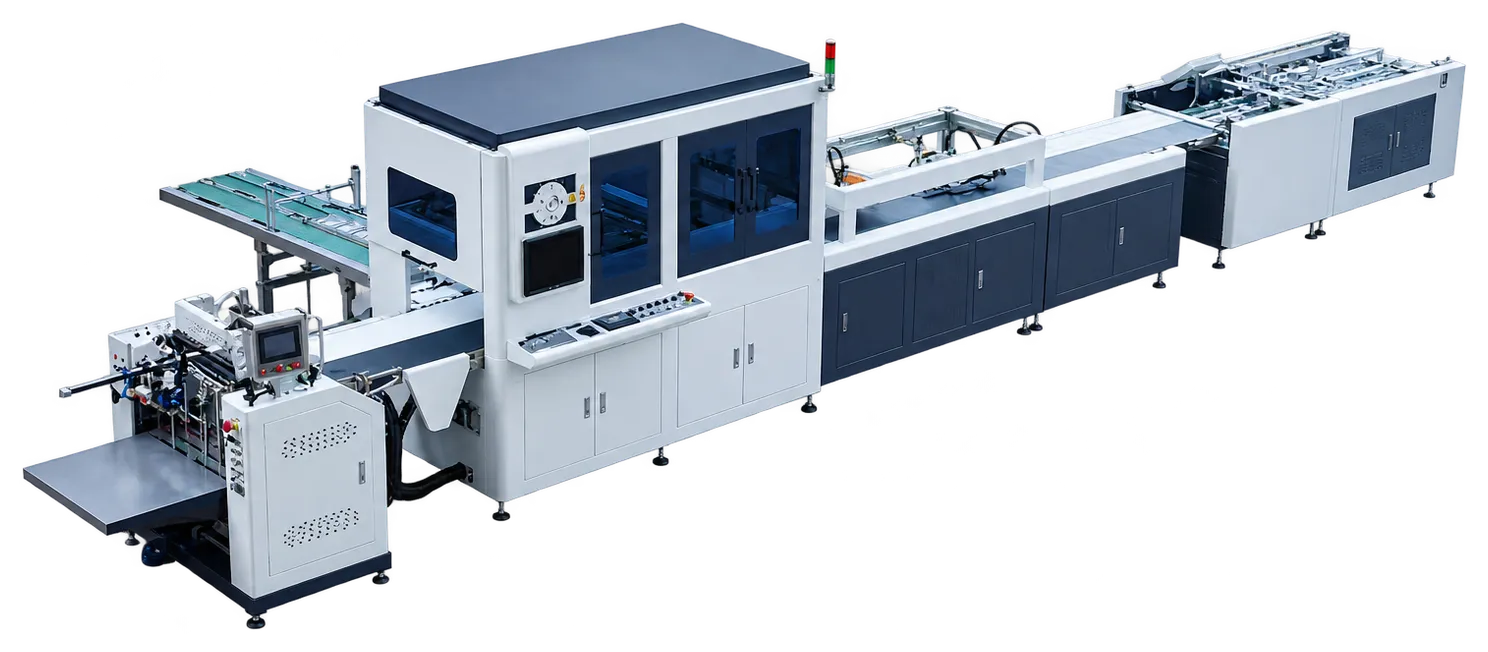 | 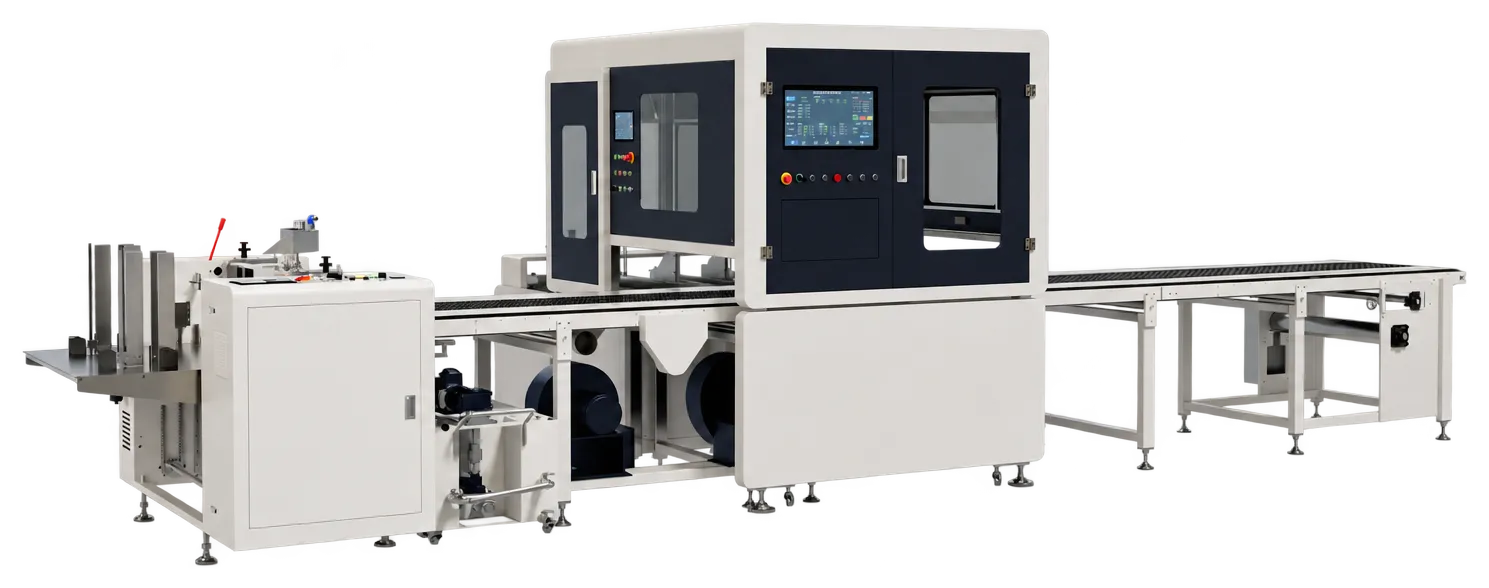 | 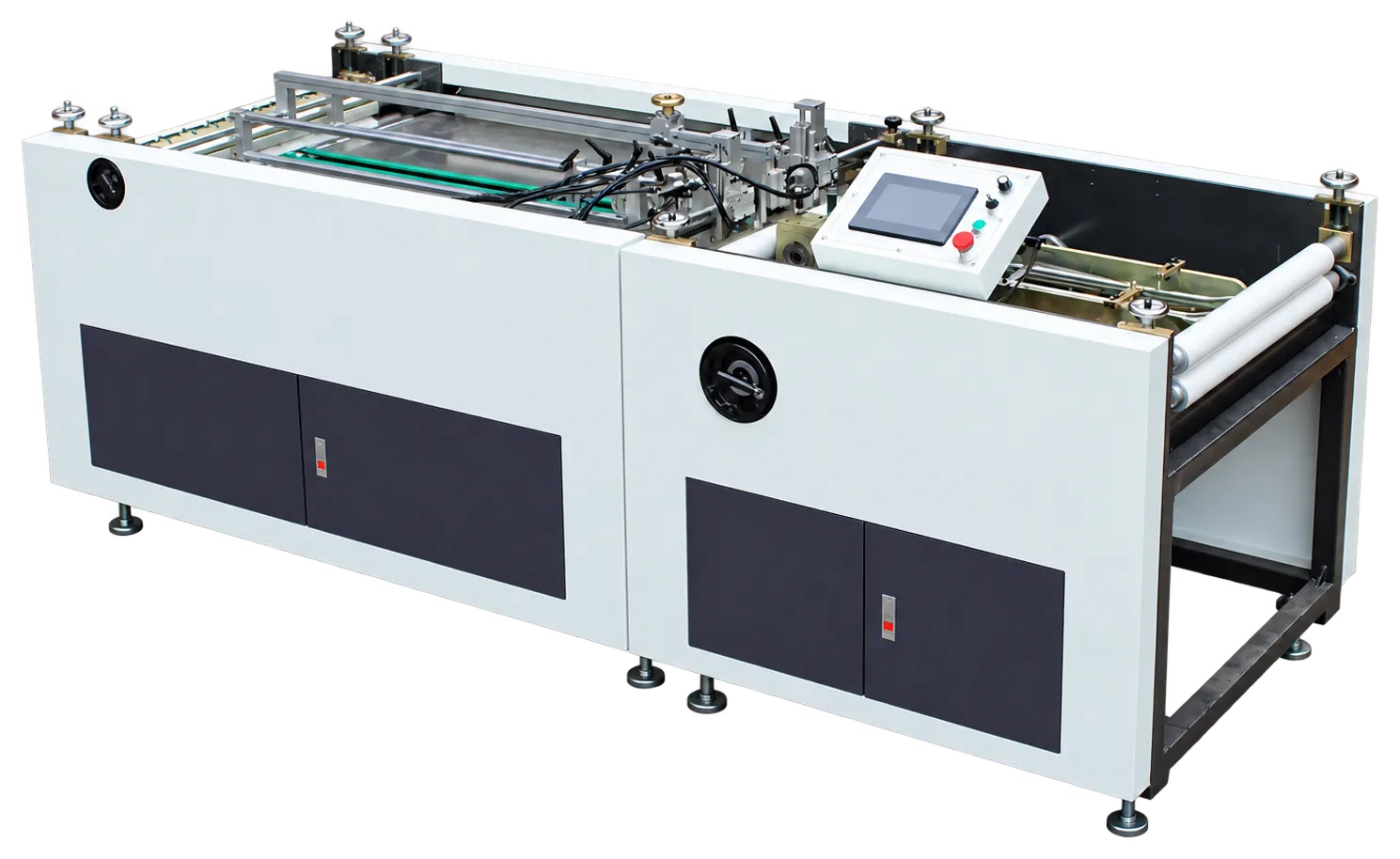 |
|---|---|---|---|
| Speed | 20–30 pcs/min | 15–30 sheets/min | 20–30 pcs/min |
| Largest case | 1000 × 500 mm | 1000 × 500 mm | 1000 × 500 mm |
| Smallest case | 200 × 100 mm | 150 × 70 mm | 150 × 90 mm |
| Minimum spine | 10 mm | 15 mm (narrower spines need customised parts) | — |
| Positioning accuracy | ±0.1 mm | ±0.1 mm | — |
| Board thickness | 1–4 mm | 1–3 mm | 1.2–4 mm |
| Paper weight | 80–300 g/m² | 100–350 g/m² | 100–250 g/m² |
| Motor or heating power | 10.5 kW / 380 V, 3-phase | 7.5 kW | 2.5 kW / 220 V |
| Weight | 3,000 kg | 2,000 kg | 800 kg |
| Footprint (L × W × H) | 10500 × 2050 × 2050 mm | 7000 × 3500 × 2000 mm | 2700 × 1160 × 1220 mm |
The working range of each route
On the two-machine route a case has to pass through both machines, so the range of the pair is the overlap of the two. That narrows it in some directions and widens it in one.
| HF-550 | HF-1050 + HF-900 | |
|---|---|---|
| Largest case | 1000 × 500 mm | 1000 × 500 mm |
| Smallest case | 200 × 100 mm | 150 × 90 mm |
| Minimum spine | 10 mm | 15 mm; narrower needs customised parts |
| Board thickness | 1–4 mm | 1.2–3 mm |
| Paper weight | 80–300 g/m² | 100–250 g/m² |
| Separate boards | 1–6 | Not stated |
| Electricity | 380 V three-phase | 380 V for the HF-1050, 220 V for the HF-900 |
The HF-550 has the wider range in board and paper and takes the narrow spines. The two-machine route goes down to smaller cases.
Floor space and power
The HF-550 is long and narrow: 10.5 × 2.05 m, 3,000 kg, with a 10.5 kW motor and 6 kW of heating. The HF-1050 is 7.0 × 3.5 m and 2,000 kg, with 7.5 kW and 4 kW of heating; the HF-900 adds 2.7 × 1.16 m, 800 kg and 2.5 kW. Placed end to end the pair is a little shorter than the HF-550 but wider at the positioning machine.
When the HF-550 case maker is the better choice
- You only make cases: book covers, folders, calendars, the covers of book-style boxes.
- Your cases have narrow spines (10–15 mm) or up to 6 separate boards.
- You run board thicker than 3 mm or paper lighter than 100 g/m².
- You want one machine with one control system rather than two machines to set.
When the HF-1050 with the HF-900 is the better choice
- You make rigid boxes as well as cases: the same HF-1050 feeds a box forming machine on other days.
- You already own a four-side wrapping machine and want to automate the gluing and positioning in front of it.
- Your cases are smaller than 200 × 100 mm.
- You want to add capacity in stages rather than in one purchase.
The semi-automatic route: HF-850A and HF-900
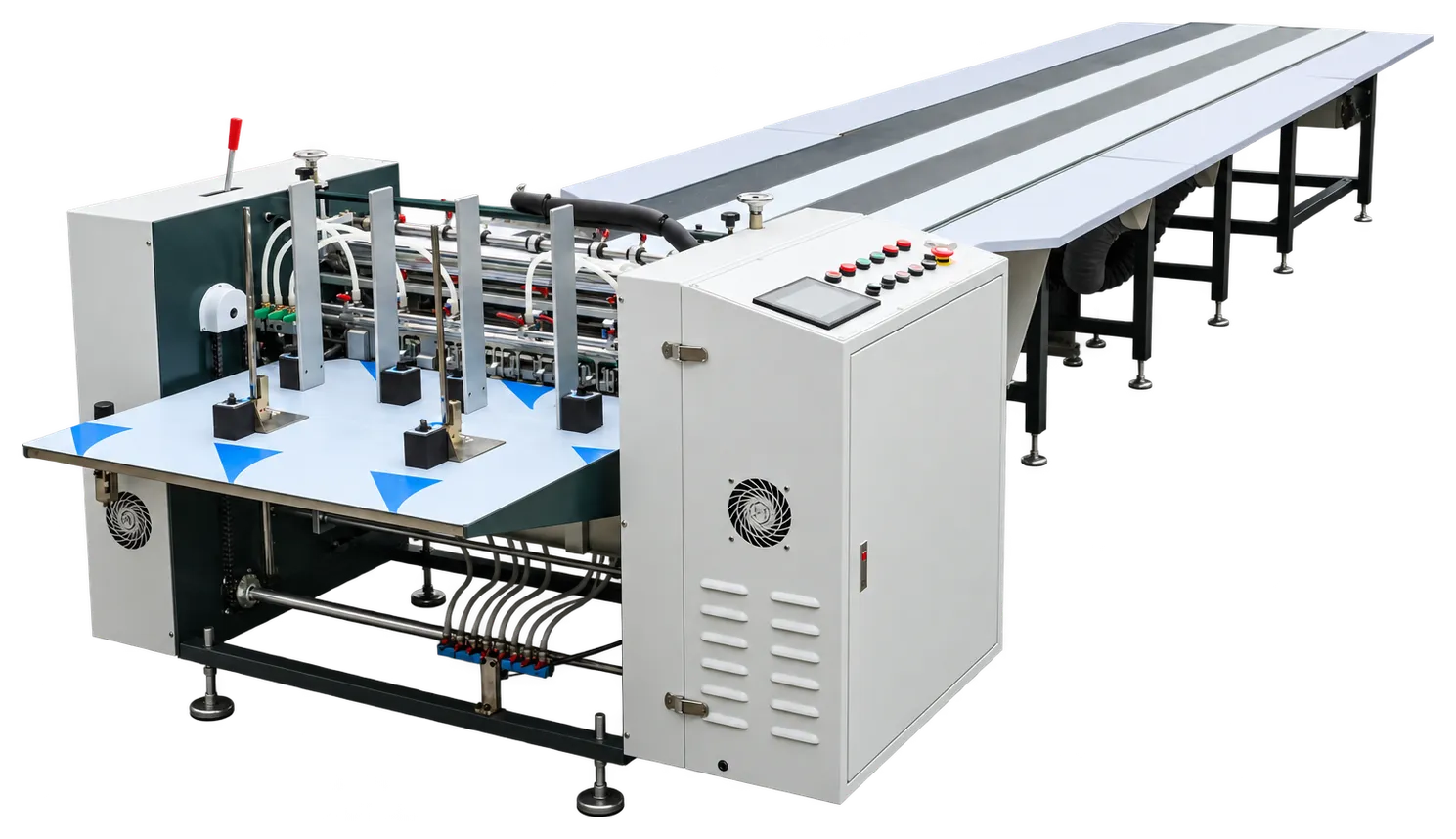
The simplest way to make cases keeps the HF-900 and puts an HF-850A gluing machine in front of it. An operator lays the boards on the glued sheet by hand, and the HF-900 wraps the four edges at 20–30 pieces per minute. The accuracy then depends on the operator. A Yamaha robot can be added to the servo version of the HF-850A later to automate the positioning.
What comes before and after the case maker
- 01
- 02
After: glue spraying
The HF-600 sprays glue on the case where the inner box will sit, along a programmed path.
- 03
Machines in this guide
Common questions
Which is faster, a case maker or a positioning machine with a wrapping machine?
Neither. The HF-550 runs 20–30 pieces per minute. The HF-1050 positions 15–30 sheets per minute and the HF-900 wraps 20–30, so both routes top out at 30 pieces per minute.
What is the largest hardcover case these machines can make?
1000 × 500 mm finished size on both routes. The smallest is 200 × 100 mm on the HF-550 and 150 × 90 mm on the HF-1050 with the HF-900.
What is the narrowest spine a case maker can handle?
The HF-550 takes a middle strip of 10 mm. The HF-1050 needs 15 mm as standard, and narrower spines need customised parts.
How many boards can the HF-550 position in one case?
From 1 to 6 separate boards, placed by a Yamaha robot guided by two 10-megapixel cameras, to ±0.1 mm.
Can I make cases without a camera positioning machine?
Yes. An HF-850A gluing machine coats the paper, an operator positions the boards by hand, and an HF-900 wraps the four edges at 20–30 pieces per minute.
Can the HF-900 be used on its own?
It wraps the four edges of a case that has already been glued and positioned, so it always follows a gluing step: an HF-850A with hand positioning, or an HF-1050.